
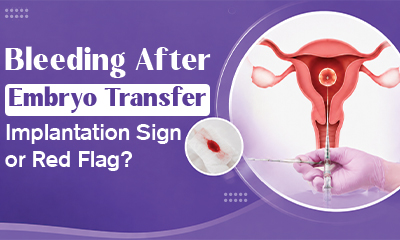
For most patients walking out of an embryo transfer at our Hyderabad centre, the two-week wait is the hardest part of the entire IVF journey — and any drop of blood during that window can feel like a verdict has already been passed. The truth is more reassuring: bleeding after IVF is not, by itself, a sign of either success or failure. It’s a symptom that needs context — its color, amount, timing, and accompanying signs — before anyone can say what it means.
At Kiran Infertility Center Hyderabad, our fertility specialists field this exact question from patients almost every day. Here’s the honest, clinical picture.
Spotting After IVF Embryo Transfer
Spotting after an embryo transfer is one of the most frequently reported experiences in an IVF cycle, and for good reason — several ordinary processes in the body can trigger it.
Implantation-related spotting: When the embryo attaches itself to the uterine wall, tiny capillaries in the endometrium can rupture. This typically produces a faint pink or brownish stain, appearing anywhere between day 5 and day 10 after transfer, and rarely lasts beyond a couple of days.
Catheter-related irritation: The embryo transfer procedure passes a soft catheter through the cervical canal. In sensitive patients, this can cause mild irritation that shows up as spotting within 24–48 hours of the procedure — unrelated to implantation altogether.
Hormonal support fluctuations: IVF cycles depend on progesterone and estrogen supplementation to prepare and sustain the uterine lining. As dosing is adjusted or as the body responds to these hormones, some women notice light, irregular spotting.
An approaching period: If implantation hasn’t occurred, the uterine lining eventually sheds, and this shows up as bleeding that looks and feels like a regular period.
How to Recognize “Reassuring” Spotting
- Color: pink, light red, or brown — not bright red
- Volume: a few spots on a liner, not a soaked pad
- Duration: typically resolves within 1–3 days
- Pain: absent, or only mild cramping
Does Bleeding Mean IVF Has Failed?
Not necessarily — and this is where many patients jump to the wrong conclusion. Clinical experience and published data both show that a meaningful share of women who spot after transfer go on to receive a positive pregnancy test. Bleeding on its own is simply not a reliable predictor either way. Some patients who become pregnant experience no spotting at all, while others who spot heavily still see a positive Beta hCG result.
When Bleeding Signals a Problem
Certain patterns should never be brushed aside. Contact your fertility team at Kiran Infertility Center Hyderabad immediately if you notice:
- Bleeding heavier than a normal period, or the need to change a pad frequently
- Passage of large clots
- Sharp, persistent, or worsening abdominal pain
- Dizziness, fainting, or unusual fatigue alongside the bleeding
- Fever, which may point to infection
The Only Reliable Way to Know
Home pregnancy kits can give misleading results during an IVF cycle because of the hormonal medications involved. The definitive test is a Beta hCG blood test, done 10–14 days after embryo transfer, which our team at Kiran Infertility Center Hyderabad will schedule and interpret for you directly.
If You Notice Bleeding — What to Do
- Stay calm; light spotting is common and rarely a bad sign.
- Continue all prescribed medications — never stop progesterone or other support on your own.
- Track the color, amount, and duration to share with your doctor.
- Rest and avoid strenuous physical activity.
- Call our Hyderabad clinic if bleeding matches any of the warning signs above.
Why Patients in Hyderabad Trust Kiran Infertility Center
With decades of combined clinical experience, thousands of successful outcomes, and continuous monitoring through every stage of the IVF cycle, our Hyderabad team is equipped to guide you through exactly this kind of uncertainty — not with guesswork, but with proper evaluation, hormone tracking, and ultrasound support where needed.
If you’ve noticed bleeding after your embryo transfer and want clarity rather than anxiety, reach out to our fertility specialists for a same-day consultation.
FAQs
1. Does bleeding after IVF mean the cycle has failed?
Not necessarily. Bleeding can occur in both successful and unsuccessful cycles, so it isn’t a dependable sign either way. A Beta hCG blood test is the only way to know for certain.
2. When does implantation bleeding usually happen after embryo transfer?
It generally shows up between 5 and 10 days after transfer and clears up within a day or two in most cases.
3. How do I know if it’s implantation spotting or the start of my period?
Implantation spotting is usually light pink or brownish, very small in quantity, and passes quickly with little to no discomfort. A period is typically heavier, brighter red, longer-lasting, and accompanied by stronger cramps.
4. If I notice spotting, should I stop taking my fertility medications?
No — continue all medications as prescribed. Never discontinue progesterone or other supportive medication without first consulting your fertility specialist.
5. What is the right time to take a pregnancy test after embryo transfer?
The most reliable option is a Beta hCG blood test done 10–14 days post-transfer. Home urine tests can be inaccurate during an IVF cycle due to the hormonal medications involved.