
How to choose the best Blastocyst for transfer
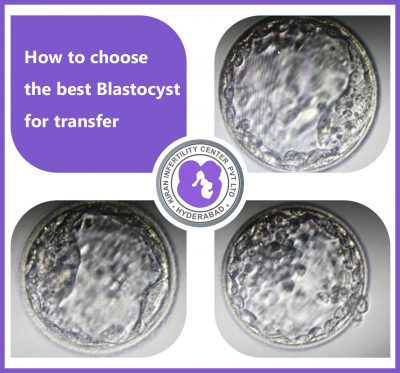
Blastocysts Transfer
One of the bigger challenges during an IVF cycle is choosing the best Blastocysts for transfer. After about 5 days the embryos reach the Blastocyst stage and start to differentiate into future placental tissue and fetal tissue. This stage, when the embryo is fully expanded is best time to transfer a Blastocyst, but it is assumed that a Blastocyst that has begun to hatch is especially vigorous and as such has the greatest chances of success.
Finding chromosomally normal Blastocyst-
An embryologist cannot assess with naked eye which embryos are chromosomally normal unless preimplantation genetic testing is done. However after years of experience a trained eye can differentiate between and good quality embryo and otherwise. A morphometric approach towards embryo quality assessment by highly experienced embryologists outlines which embryonic markers are more likely to result in live birth. Embryos are grown under culture media (in a lab) under controlled conditions can mimic the human body in terms of temperature and pH.
The longer the embryos stay in culture media, the more information can be obtained by the embryologists to differentiate each embryo. From Day 1 to Day 5, the embryos are assessed and each score is taken into account for the best embryo(s) to be transferred.
Patients should be advised that the grade of the embryo is not a perfect method of predicting the health of the fetus/baby. It may be possible that a perfectly formed and healthy baby may result/form from embryos that are classified as average.
Chances of Day 5 balstocyst implantation
Studies have shown that the traphecopderm (the outer cells of the blastocyst that makes the placenta) are the most important embryonic marker for implantation success. The cells should appear cohesive and scalloped and the inner cell mass or ICM (that forms the fetus) is also very important to score and contributes to the overall grade of the embryo. The inner cells should be very obvious and the blastocele (fluid filled centre) should be expanded and the zona should be thin.
Thinning of zona is very important for hatching of the blastocyst as when the blastocyst expands and when zona is thin, it allows the hatching out that must occur for implantation into endometrium. Stage–5 blastocyst with A grades for both inner cell mass and trophectoderm (written as 5AA) are thought to be ideal for transfer. Freezing embryos at the blastocyst stage through vitrification leads to 95% and upwards survival of the embryos after warming them. This may also lead to a much higher pregnancy rate during a frozen embryo transfer cycle.
#IVF #embryotransfer #blastocyst #blastocysttransfer #infertility #infertilitytreatment #kichyderabad #embryo #infertilityawarenesss #femaleinfertility #maleinfertility #surrogacyindia #surrogacylawsindia #ivfinindia #eggdonorsurrogacy #surrogacyhyderabad

Leave a Reply